Guide · QA + AI series · 19/31 · November 13, 2026 · 7 min read
Cost as a quality metric: top-K prefiltering before the model
How to cut an agent's input tokens with a local candidate prefilter and prove with measurements that quality doesn't drop.
In QA we're used to quality being measured in defects. With systems that use models, cost becomes an equally concrete quality dimension: a feature that gets it right but costs too much per call can't be sustained in production, and one that's cheap and fails is no good either. Someone has to measure both together.
The most common case of unnecessary cost is sending the model all the available context, just in case. This guide shows a technique to avoid it: a local prefilter that picks the K most relevant candidates before calling the model. And it shows how to test it, because a badly measured prefilter lowers cost and quality alike without anyone noticing.
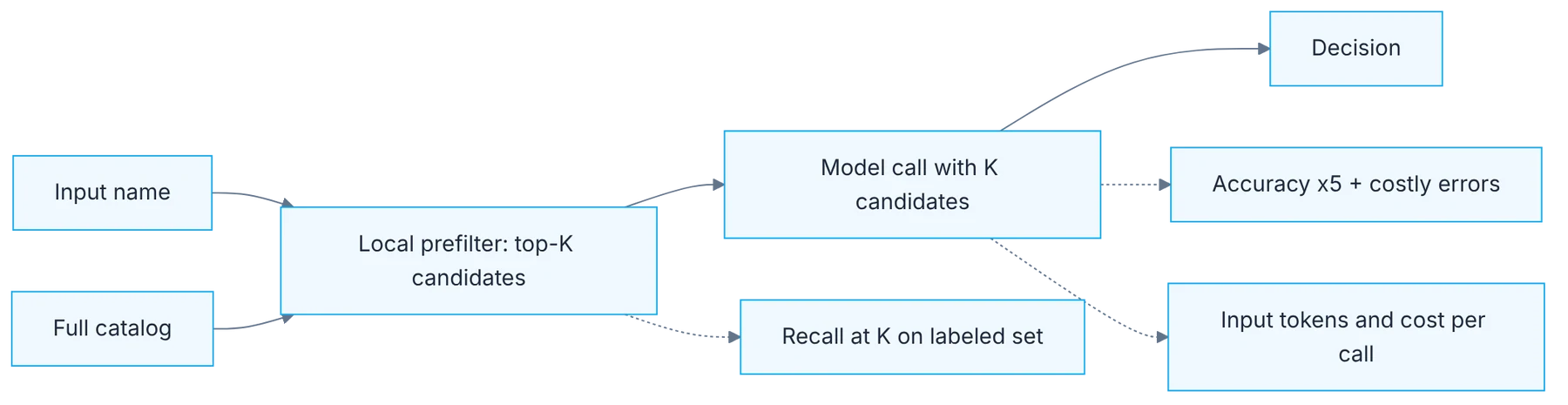
How it fits together
Show the diagram as text
input name ──┐
full catalog ┴─▶ local prefilter: top-K candidates ─▶ model call ─▶ decision
                       │                                  │
                       ▼                                  ▼
            recall at K (labeled set)      accuracy x5 + costly errors
                                           input tokens and cost per call
Requirements
- The day 18 case: names to map against a catalog.
- A labeled set with the correct answer per name.
Setup
const grams = (s) => {
  const t = "  " + s.toLowerCase() + " ";
  const g = new Set();
  for (let i = 0; i < t.length - 2; i++) g.add(t.slice(i, i + 3));
  return g;
};

const sim = (a, b) => {
  const A = grams(a);
  const B = grams(b);
  let inter = 0;
  A.forEach((x) => B.has(x) && inter++);
  return inter / (A.size + B.size - inter);
};

export const topK = (query, catalog, k = 10) =>
  catalog
    .map((c) => ({ c, s: sim(query, c) }))
    .sort((x, y) => y.s - x.s)
    .slice(0, k)
.map((x) => x.c);Step by step
1. The baseline
Measure the baseline: input tokens per call and how much is fixed context (for example, the whole catalog).
Before optimizing, measure. For a sample of calls, record how many input tokens each one uses and how many correspond to fixed context repeated every time, such as a whole catalog or a full document. In many systems that fixed part is most of the cost. Also note current quality with the eval you already have. Without those two numbers, tokens and quality, you won't be able to say afterwards whether the change was an improvement or merely a change.
2. A simple local prefilter
Build a local prefilter that picks the K most similar candidates. Start with a simple lexical one: it's free and calls no model.
The prefilter takes the input and the full candidate list, and returns the K most similar. Start with a lexical method, for example character trigram similarity: it takes a few lines to write, runs in milliseconds and calls no model. It's also deterministic, so it can be tested with classic tests. The temptation is to jump straight to something more sophisticated. Resist it until you have a number showing the simple approach falls short.
3. Prefilter recall
Measure prefilter recall: in how many labeled cases the correct answer is among the K. If it isn't there, the model can't get it right.
This is the central measurement. For each labeled case, check whether the correct answer is among the K candidates the prefilter returned. The percentage of cases where it is, is recall. It works as the ceiling for the whole system: if the correct answer doesn't reach the context, the model has no way of choosing it, however good it is. It's a deterministic, cheap, fast test, and it tells you whether the problem lies before the model or in the model.
4. Compare methods and K values
Compare methods (lexical versus embeddings) and K values on that same recall. Don't assume embeddings win.
With recall as the metric you can compare options fairly: lexical method against embeddings, and different K values for each. Build a table. Don't assume embeddings win. In tasks with proper names, codes or abbreviations, lexical similarity often performs as well or better, and it's free. Embeddings help when the relationship is one of meaning rather than spelling. Let your data decide.
5. The full eval with each K
Run the full eval, 5 times, with the full list and with each K. Compare accuracy, costly errors, tokens and cost.
Recall measures the prefilter, not the final result. Run the eval end to end, five times, with the full list and with each K value. Compare accuracy, costly errors, tokens and cost. You'll see something that tends to surprise: more context doesn't always give a better result. With many similar candidates in the prompt, the model gets confused more. There's a point beyond which adding candidates worsens quality and raises cost at the same time.
6. Choose the smallest K that suffices
Pick the smallest K that keeps recall and accuracy. More similar candidates can confuse the model and make results worse.
The decision rule is choosing the smallest K that keeps recall and accuracy within the baseline range. Document the full table and the chosen value. Add prefilter recall as a permanent test in CI: if someone changes the method or the catalog grows a lot, recall can drop without notice. That test takes seconds, and it protects a piece that, when it fails, makes everything after it fail.
Illustrative example
With illustrative numbers: a system sends a catalog of two thousand records on every call, about sixty thousand input tokens. The team builds a trigram prefilter and measures recall on eighty labeled cases. With K equal to five, the correct answer is present in 90% of cases; with ten, in 97%; with twenty, in 99%; with fifty, also 99%. They try embeddings and with K equal to twenty get 98%: no improvement. In the full eval, K equal to twenty gives the same accuracy as the full list, with one fewer costly error per run and around three percent of the tokens. With fifty, accuracy drops two points.
Common mistakes
- Shrinking context without measuring prefilter recall.
- Assuming embeddings beat a lexical method.
- Evaluating only cost and not end-to-end quality.
- Choosing a large K "to be safe".
Checklist: how to know it is done
- You have baseline input tokens and quality.
- Prefilter recall is measured for several K values.
- The full eval ran with the full list and with each K.
- Prefilter recall runs as a test in CI.
Where AI fell short
With many similar candidates in context, the model picks wrong more often. Context is designed and measured, not piled up.
Frequently asked questions
Is this the same as RAG?
It's the same idea applied to a list of candidates: retrieve first and generate afterwards. That's why the measurements look alike. On day twenty-one we cover the case with documents, where you also need to verify the answer is faithful to what was retrieved.
Doesn't prompt caching solve the cost?
It helps with fixed, repeated context and is worth enabling when the provider offers it. It doesn't solve the second problem: many similar candidates still confuse the model. Prefilter and cache complement each other.
What if the catalog changes often?
The lexical prefilter needs no retraining, only the updated list. What does need repeating is the recall measurement when the catalog grows a lot or changes in nature, because the K that was enough may fall short.
Day 19 of 31 of the 31 days of QA + AI series. Commands and versions reviewed in November 2026: rerun them before relying on them, AI tooling changes fast.
← Previous: How to test a model: accuracy, N runs and ranges
Next: Prompt regression: version, compare and don't break what worked →